
Conversation Topics | 2026-06-10
World Cup 2026 Winning Probabilities Explained
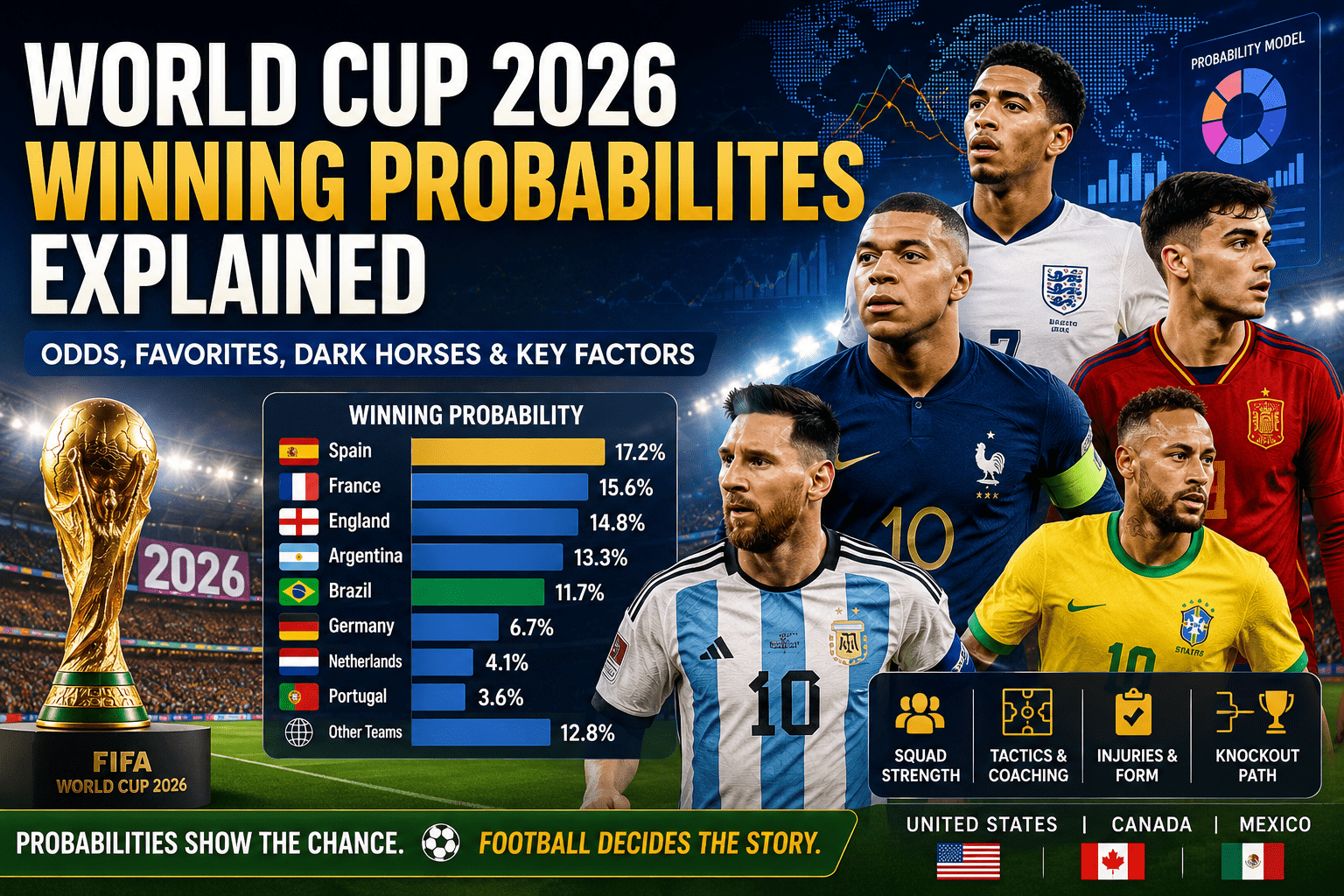
World Cup 2026 winning probabilities represent how likely each team is to win the tournament, based on statistical models, expert analysis, and bookmaker odds. These numbers help fans understand which teams are considered favorites, which are dark horses, and how the tournament bracket may shape the path to the final. Probabilities change as the tournament progresses because results, injuries, and matchups affect each team's chances in real time.
What Do World Cup Winning Probabilities Mean?
Winning probabilities express how likely a team is to win the entire World Cup tournament. A team with a 17% probability is considered to have roughly a 1 in 6 chance of lifting the trophy. These numbers are not certainties. They reflect current information, form, squad strength, and historical performance.
How Probabilities Are Calculated
Most World Cup winning probabilities come from a mix of sources:
- Statistical models that simulate thousands of possible tournament outcomes
- Bookmaker odds based on betting markets
- Expert analysis from journalists and former players
- Team rankings and recent form
- Squad depth and player availability
Different sources may give different numbers for the same team. That is normal because each model weighs factors differently. Some focus more on recent results, while others prioritize historical World Cup performance.
Why Probabilities Are Not Predictions
A team with the highest probability does not always win. Probabilities describe likelihood, not certainty. In the 2022 World Cup, Argentina won despite not being the pre-tournament favorite in every model. Upsets, red cards, injuries, and penalty shootouts can change everything.
Probabilities are useful for understanding expectations, but the World Cup always delivers surprises.
How to Read Winning Probability Numbers
When you see a number like "Spain 17.2%" it means that based on current data, Spain is estimated to win the World Cup about 17 times out of 100 simulated tournaments. The remaining 83% is spread across all other teams.
Higher numbers mean a team is considered more likely to win, but even the top favorite rarely has more than a 20-25% chance. That means the field is always competitive.
Which Teams Are Favorites to Win the 2026 World Cup?

Based on early tournament data, bookmaker consensus, and pre-tournament models, several teams stand out as favorites for the 2026 World Cup. According to a Reuters report from June 3, 2026, bookmaker odds placed the following teams among the top contenders:
| Team | Estimated Winning Probability |
|---|---|
| Spain | ~17.2% |
| France | ~15.6% |
| England | ~14.8% |
| Argentina | ~12.4% |
| Brazil | ~9.5% |
| Germany | ~8.1% |
These numbers shift as the tournament progresses. A strong group stage performance can increase a team's probability, while an early scare or key injury can lower it.
Why Spain Leads Many Pre-Tournament Models
Spain enters the 2026 World Cup as a top favorite due to their 2024 European Championship victory, a deep and young squad, tactical flexibility, and consistent performances in major tournaments. Their midfield depth and possession-based style make them difficult to beat over multiple matches.
France and England as Strong Contenders
France brings World Cup pedigree (winners in 2018, finalists in 2022) and a squad full of attacking talent. England has consistently reached the later stages of recent tournaments and has one of the strongest squads in terms of individual quality.
Both teams have the depth to handle the expanded 48-team format, which requires more matches and squad rotation.
Argentina as Defending Champions
Argentina enters as defending champions after winning in Qatar 2022. While still a strong team, some models give them slightly lower odds due to squad transitions and the challenge of defending a title in a new format.
What Factors Affect World Cup Winning Probabilities?
Several factors determine how probabilities are assigned to each team. These include measurable data and harder-to-quantify elements like team chemistry and tournament experience.
Squad Strength and Player Quality
Teams with more world-class players across multiple positions tend to have higher probabilities. A strong goalkeeper, reliable defenders, creative midfielders, and clinical forwards all contribute to a team's overall rating.
Recent Tournament Performance
Teams that have performed well in recent World Cups, continental championships, or Nations League competitions are typically rated higher. Consistent deep runs suggest a team can handle tournament pressure.
Group Stage Draw and Bracket Path
The group stage draw affects probabilities because some groups are harder than others. A team in an easier group has a higher chance of advancing, while a team facing strong opponents early may have lower overall odds.
The knockout bracket also matters. Two favorites on the same side of the bracket cannot both reach the final, which lowers one team's probability.
Injuries and Suspensions
Key player injuries can significantly change a team's winning probability. If a star player is injured before or during the tournament, models adjust the team's expected performance downward.
The Expanded 48-Team Format
The 2026 World Cup is the first with 48 teams, which means more matches, more fatigue, and more chances for upsets. This format may slightly reduce the probability gap between favorites and dark horses because deeper squads and better rotation become more important.
How Do Group Stage Results Change Probabilities?
Once the tournament begins, probabilities are no longer based on pre-tournament estimates. They update after every match based on actual results.
Winning All Group Matches
A team that wins all group matches often sees its probability increase because it demonstrates form, confidence, and squad depth. It also usually secures a more favorable knockout draw.
Drawing or Losing Early
An early draw or loss does not eliminate a team, but it lowers their probability. It may also affect their knockout path by placing them on a harder side of the bracket.
Goal Difference and Tiebreakers
In the group stage, goal difference can determine which teams advance. A team that wins by large margins may get a more favorable path, which indirectly affects their overall winning probability.
Why Do Knockout Rounds Change Everything?

The knockout stage is where probabilities shift most dramatically. Every match is elimination, so one bad game, one mistake, or one penalty shootout can end a favorite's tournament.
Single-Match Elimination Increases Uncertainty
In a league format, the best team usually wins over many matches. In knockout football, a single match can go either way. This means that even a team with a 15% pre-tournament probability can be eliminated in the Round of 32 if things go wrong on the day.
Penalty Shootouts Add Randomness
Penalty shootouts are notoriously unpredictable. Even the best teams can lose on penalties, which adds a layer of randomness that models struggle to fully capture.
Fatigue and Squad Depth Matter More
As the knockout rounds progress, teams play more frequently with less recovery time. Teams with deeper squads and better rotation options tend to maintain their performance level longer, which is reflected in their probabilities.
Dark Horses and Surprise Teams
Every World Cup has teams that exceed expectations. These are often called "dark horses" because their pre-tournament probabilities are lower, but they have the quality to beat stronger teams on their day.
What Makes a Team a Dark Horse?
A dark horse typically has:
- A strong core of players in good form
- A clear tactical identity
- Recent improvement in results
- Less pressure compared to traditional favorites
- A favorable group or bracket path
Potential Dark Horses for 2026
Teams like Portugal, Netherlands, Colombia, and host nations (USA, Mexico, Canada) are sometimes mentioned as dark horses depending on their draw and form. Host nation advantage can be significant because of home support, no travel fatigue, and familiar conditions.
Why Dark Horses Make the World Cup Exciting
If the favorites always won, the tournament would be predictable. Dark horses create the upsets, dramatic moments, and unexpected storylines that make the World Cup special. For fans, supporting or discussing dark horses adds excitement to every match.
How to Talk About Probabilities with Other Fans
World Cup winning probabilities are a great conversation topic because every fan has an opinion about which team deserves to be the favorite. You can use probabilities to start debates, challenge predictions, and discuss what might happen next.
Good Questions to Ask Other Fans
- "Do you think Spain deserves to be the top favorite?"
- "Which team do you think is underrated?"
- "Can any dark horse actually win the whole thing?"
- "Which factor matters most: squad depth, form, or bracket luck?"
- "Do you trust the bookmakers or your own gut feeling?"
Using Probabilities to Start Match-Day Conversations
Before a match, you can compare what the models say with what you expect. After the match, you can discuss whether the result changed anything. This gives you a natural reason to chat with other fans before, during, and after every game.
Why Disagreement Makes the Conversation Better
Not everyone will agree with the probabilities. Some fans trust the numbers, while others back their instincts. Both approaches are valid, and the disagreement is what makes World Cup conversations interesting. A friendly debate about which team is overrated or underrated can keep the conversation going for the entire tournament.
Connect with Fans and Discuss World Cup Predictions

The World Cup is more fun when you can share your predictions, challenge other opinions, and react to results as they happen. Whether you trust the models, follow your gut, or just enjoy the debate, talking about probabilities with other fans makes every match feel more engaging.
With LivU, you can start video chats with fans who are following the same matches, discuss which teams are overrated or underrated, and share your reactions after every result. It turns World Cup watching into a social experience where predictions, surprises, and debates bring fans together from around the world.
Conclusion
World Cup 2026 winning probabilities give fans a way to understand which teams are favored, how odds work, and why certain teams are rated higher than others. But probabilities are not certainties. The World Cup always delivers surprises, upsets, and moments that no model can predict.
Use probabilities as a starting point for conversation, not the final answer. The most important thing is enjoying the tournament, sharing reactions with other fans, and staying open to the unexpected. Whether you back the favorites or believe in a dark horse, the World Cup is more fun when you can talk about it with people who care about the same matches.
FAQ
What Does It Mean When a Team Has a 17% Winning Probability?
It means that based on current models and data, the team is estimated to win the World Cup about 17 times out of 100 simulated tournaments. It does not mean they will definitely win or definitely lose. It reflects their relative strength compared to other teams.
Why Do Different Sources Give Different Probabilities?
Different sources use different models, data inputs, and assumptions. Some focus more on recent form, others on historical performance, squad value, or betting market data. Small differences are normal and expected.
Can the Favorite Actually Lose Early?
Yes. In every World Cup, at least one pre-tournament favorite exits earlier than expected. The knockout format means one bad match can end a campaign. Injuries, red cards, and penalty shootouts all add uncertainty.
How Often Does the Pre-Tournament Favorite Win?
Not always. Over the last several World Cups, the pre-tournament favorite has won some tournaments but lost in others. The World Cup is competitive enough that multiple teams have realistic chances.
What Is a Dark Horse in World Cup Terms?
A dark horse is a team that is not among the top favorites but has the quality to surprise. They typically have lower winning probabilities but can beat stronger teams if conditions are right.
Do Probabilities Change During the Tournament?
Yes. Probabilities update after every match based on results, injuries, and bracket paths. A team that wins convincingly in the group stage will see its probability increase, while an early upset will lower a favorite's chances.
Should I Trust Probabilities When Making My Own Predictions?
Probabilities are useful as a reference point, but they should not replace your own judgment. Use them to understand general expectations, then factor in your own knowledge of teams, players, and match context.
How Can I Discuss Probabilities with Other Fans?
You can start by asking which team other fans think is overrated or underrated. Compare what the models say with personal opinions. Discuss whether recent results should change the numbers. These topics work well before, during, and after matches.


